The Integration & Operational Data Backbone for Modern Commerce
APIWORX combines the deep, specialized data models of a traditional systems integrator with the speed, scale, and observability of a modern serverless platform. Not just analytics after the fact. Not just a black-box sync tool. Automation in the flow, built on a governed data foundation.
The Commerce Difference
APIWORX is purpose-built for operational commerce — not a generic tool adapted for integration.
Execution Model
Requires internal build effort
Prebuilt commerce connectors with managed workflow execution.
Data Normalization
Usually limited or DIY
Nexus: a reusable, unified operational data layer.
Visibility
Varies heavily by tool setup
Native observability built into the platform core.
Management
DIY toolset / consultant-led
100% managed service wrapper backing a productized platform.
Technology Stack
A modern, serverless-first architecture designed for reliability, performance, and developer experience.
Frontend
React 18, Vite, TypeScript, Tailwind CSS, shadcn/uiState managed via TanStack React Query. Optimistic updates and real-time subscriptions provide instant feedback.
Backend & Edge
Supabase Edge Functions, Deno RuntimeHandles REST APIs, webhook ingestion, and orchestration logic. Serverless architecture scales automatically with transaction volume.
Execution Engine
Isolated Workflow EngineWebhook-triggered execution engine handles complex transformations, field mappings, and target system delivery in isolated environments.
Data & Auth
PostgreSQL, JWT Auth, Encrypted Storage, RealtimeRow-Level Security enforces tenant isolation at the database level. Real-time subscriptions power live UI updates.
Cloud Infrastructure & Hosting Reliability
Enterprise-grade cloud infrastructure with auto-scaling, encryption, and disaster recovery built in.
Auto-Scaling Compute
Cloud compute environments scale dynamically based on transaction volume, ensuring consistent performance during peak loads.
Encrypted Database
All records are fully encrypted at rest in a managed relational database with automated failover and high availability.
Disaster Recovery
Near real-time snapshotting with encrypted backup records to cloud object storage ensures rapid recovery from any failure scenario.
Perimeter Security
Active server security monitoring and vulnerability scanning guard the network edge, detecting threats before they reach the application layer.

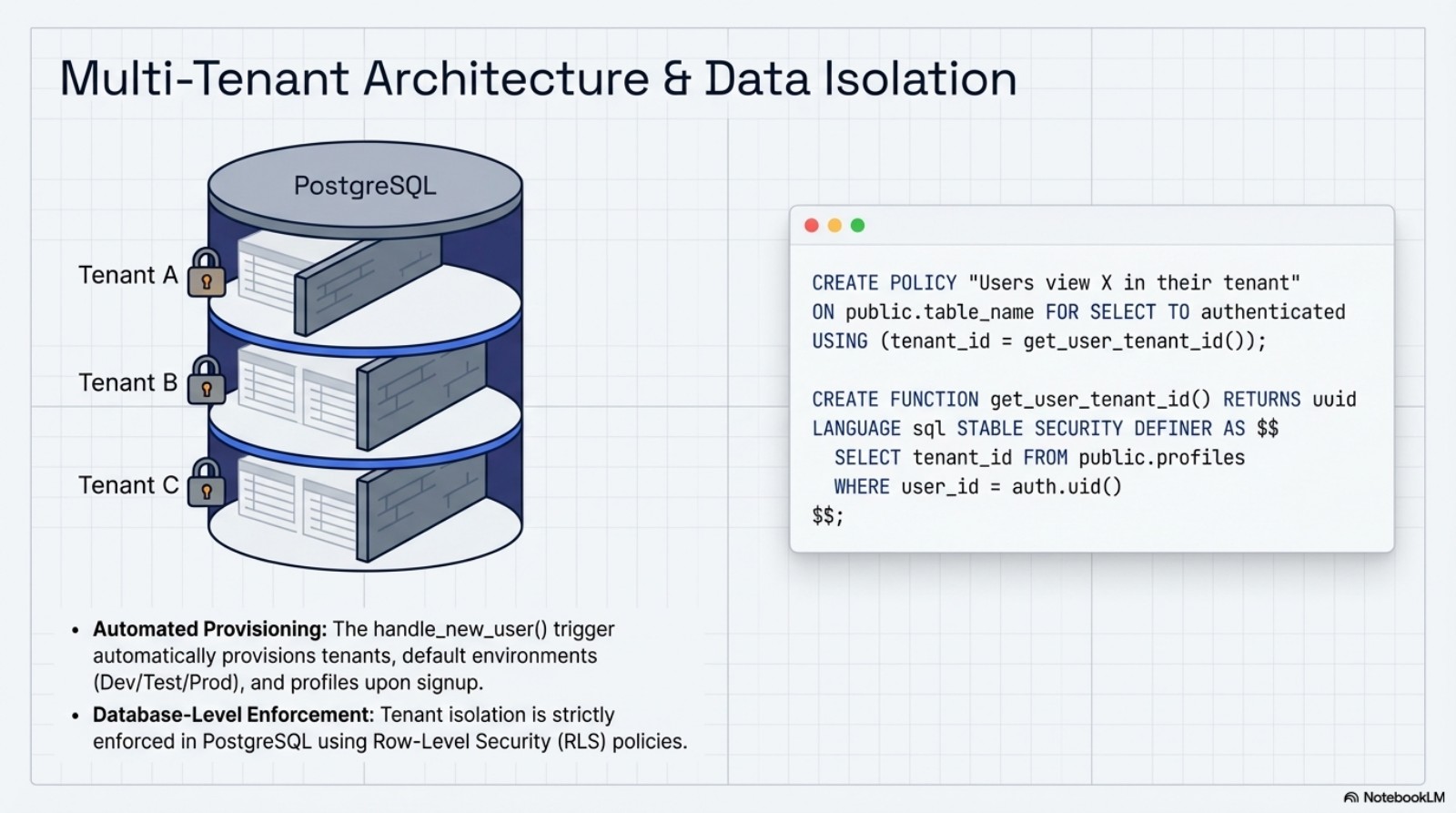
Multi-Tenant Architecture & Data Isolation
Every tenant operates in a fully isolated environment with database-level enforcement.
Database-Level Enforcement
Tenant isolation is strictly enforced in PostgreSQL using Row-Level Security (RLS) policies. Every query is automatically scoped to the authenticated tenant.
Automated Provisioning
Upon signup, every tenant is automatically provisioned with isolated Development, Test, and Production environments — no manual setup required.
Credential Isolation
API keys and secrets are hashed and encrypted at rest, isolated entirely within each tenant's specific connector instance. No cross-tenant data leakage is possible.
The Webhook Ingestion Pipeline
Every inbound event passes through a six-stage pipeline that validates, normalizes, deduplicates, and dispatches payloads with full traceability.
Validate
Look up connector instance, verify HMAC signature against stored credentials.
Detect & Normalize
Run connector-specific logic to identify event type and standardize the payload schema.
Deduplicate
Generate an idempotency key from the external event ID. Skip processing if a duplicate exists.
Create Event + Job
Insert a pending event record and queue a job. Match the payload to the correct object type.
Dispatch
Route the normalized payload to the matching flow's execution webhook URL for processing.
Log
Insert an activity log entry with full trace context. Return trace IDs for end-to-end observability.
Execution Delegation
APIWORX separates orchestration from execution to guarantee platform stability under heavy transformation loads.
Orchestration Layer
APIWORX handles orchestration, routing, and normalization. The platform manages tenants, connectors, flows, events, and jobs via edge functions.
Execution Engine
Complex transformations, field mappings, and final API deliveries are delegated to isolated, webhook-triggered workflows. This guarantees platform stability during heavy transformation loads.
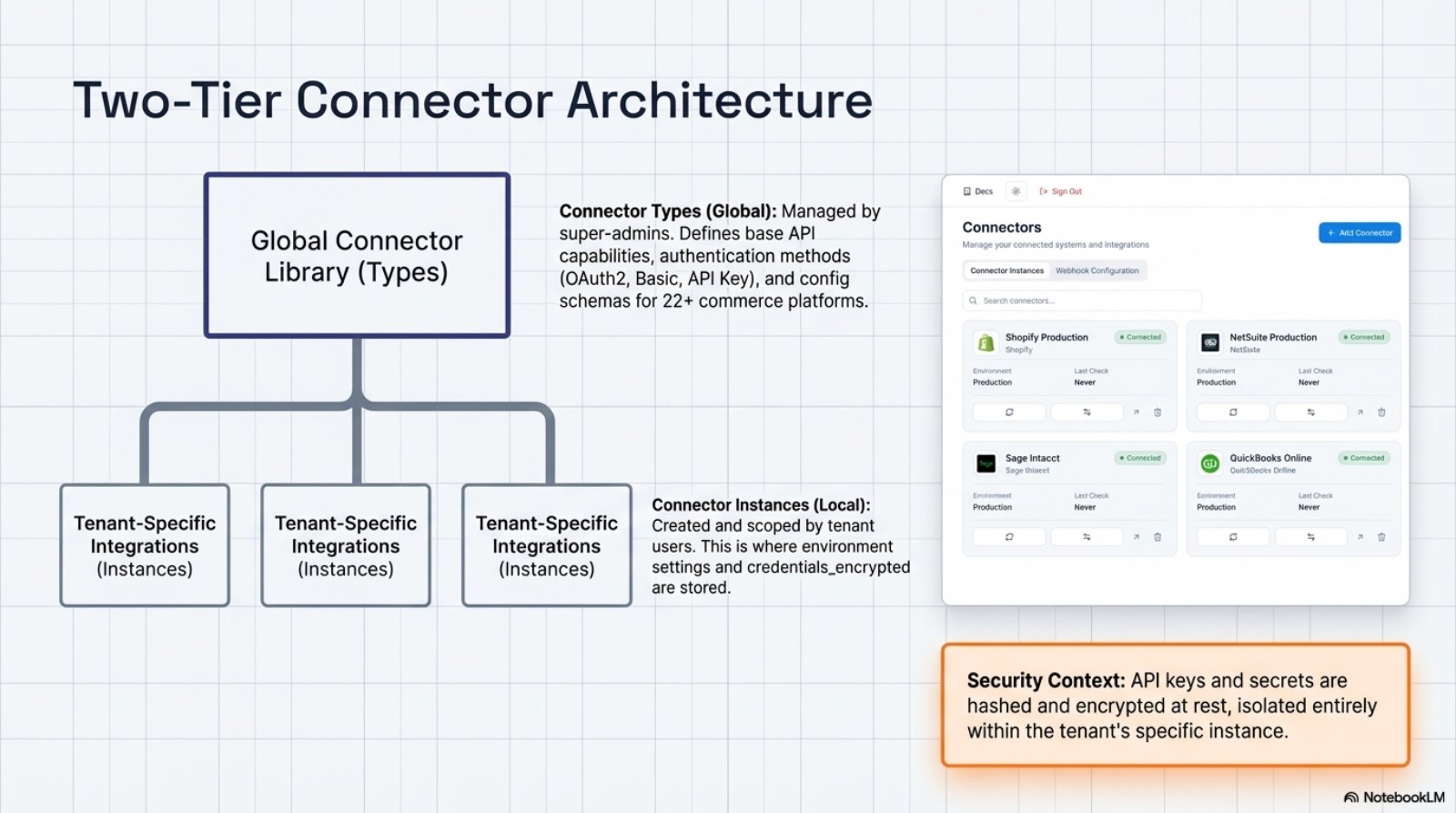
Two-Tier Connector Architecture
Global connector types define capabilities. Tenant-specific instances store credentials and configuration.
Connector Types (Global)
Managed by platform administrators. Defines base API capabilities, authentication methods (OAuth2, Basic Auth, API Key), and configuration schemas for 80+ commerce platforms including Shopify, NetSuite, Sage Intacct, QuickBooks, and more.
Connector Instances (Tenant)
Created and scoped by tenant users. Environment settings and credentials are stored in isolation. API keys and secrets are hashed and encrypted at rest, isolated entirely within each tenant's specific instance.
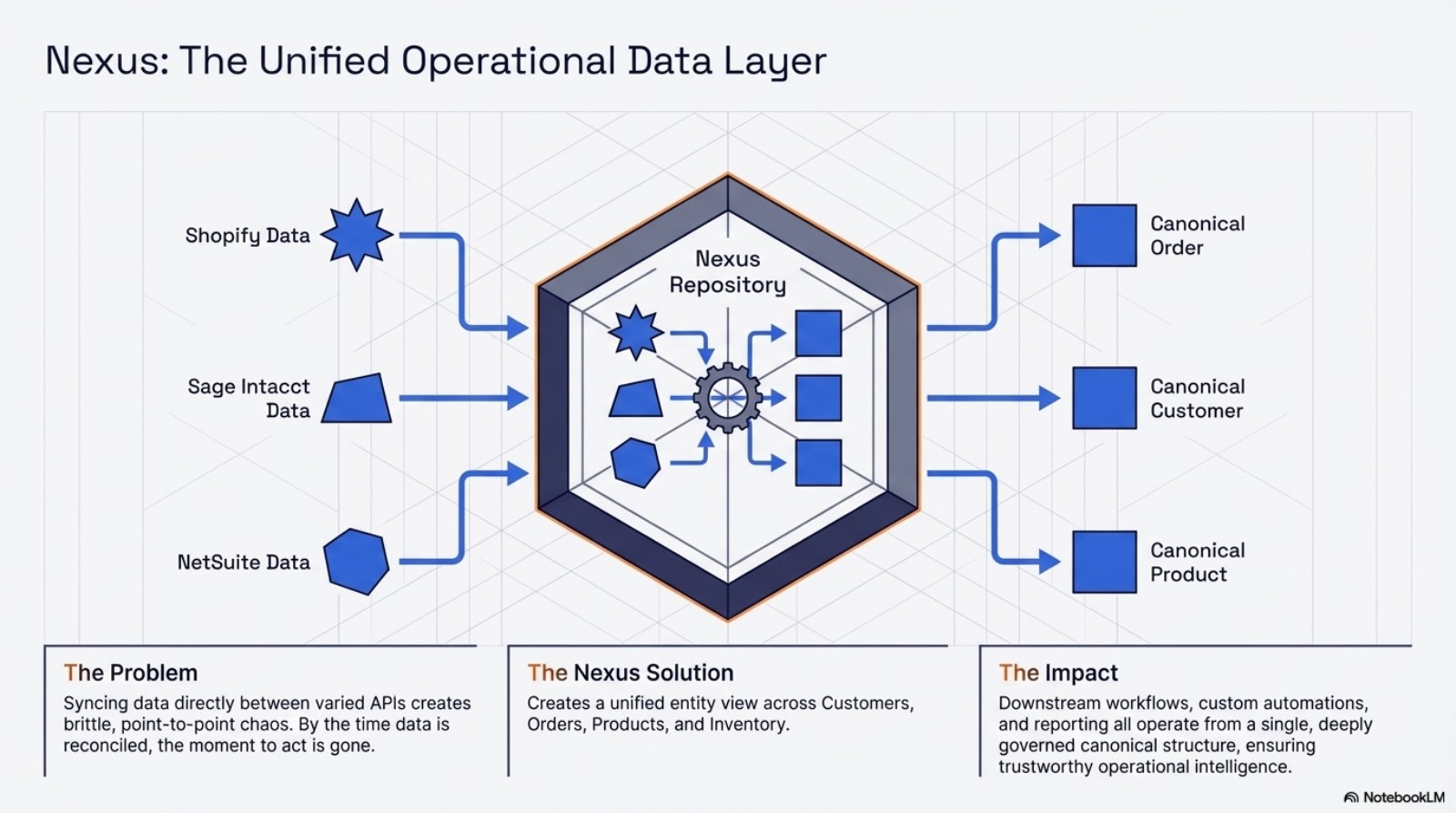
Nexus: The Unified Operational Data Layer
Syncing data directly between varied APIs creates brittle, point-to-point chaos. Nexus solves this.
The Problem
Point-to-point integrations create brittle connections. By the time data is reconciled across systems, the moment to act is gone.
The Nexus Solution
Creates a unified entity view across Customers, Orders, Products, and Inventory — a single canonical structure that all systems reference.
The Impact
Downstream workflows, custom automations, and reporting all operate from a single, deeply governed canonical structure — ensuring trustworthy operational intelligence.
Deployment & Environment Management
Every tenant receives isolated Dev, Test, and Production environments upon signup.
Development
Build and iterate on connector configurations, flow mappings, and transformation rules in a safe sandbox.
Staging
Validate integration flows with real-world data patterns before promoting to production. Full observability included.
Production
Live commerce data flows with full monitoring, alerting, and SLA-backed reliability.
Resources — including Connector Instances, Flows, Events, and Jobs — are strictly scoped to a unique environment ID. Teams can safely test complex transformations without risking corruption of production data.
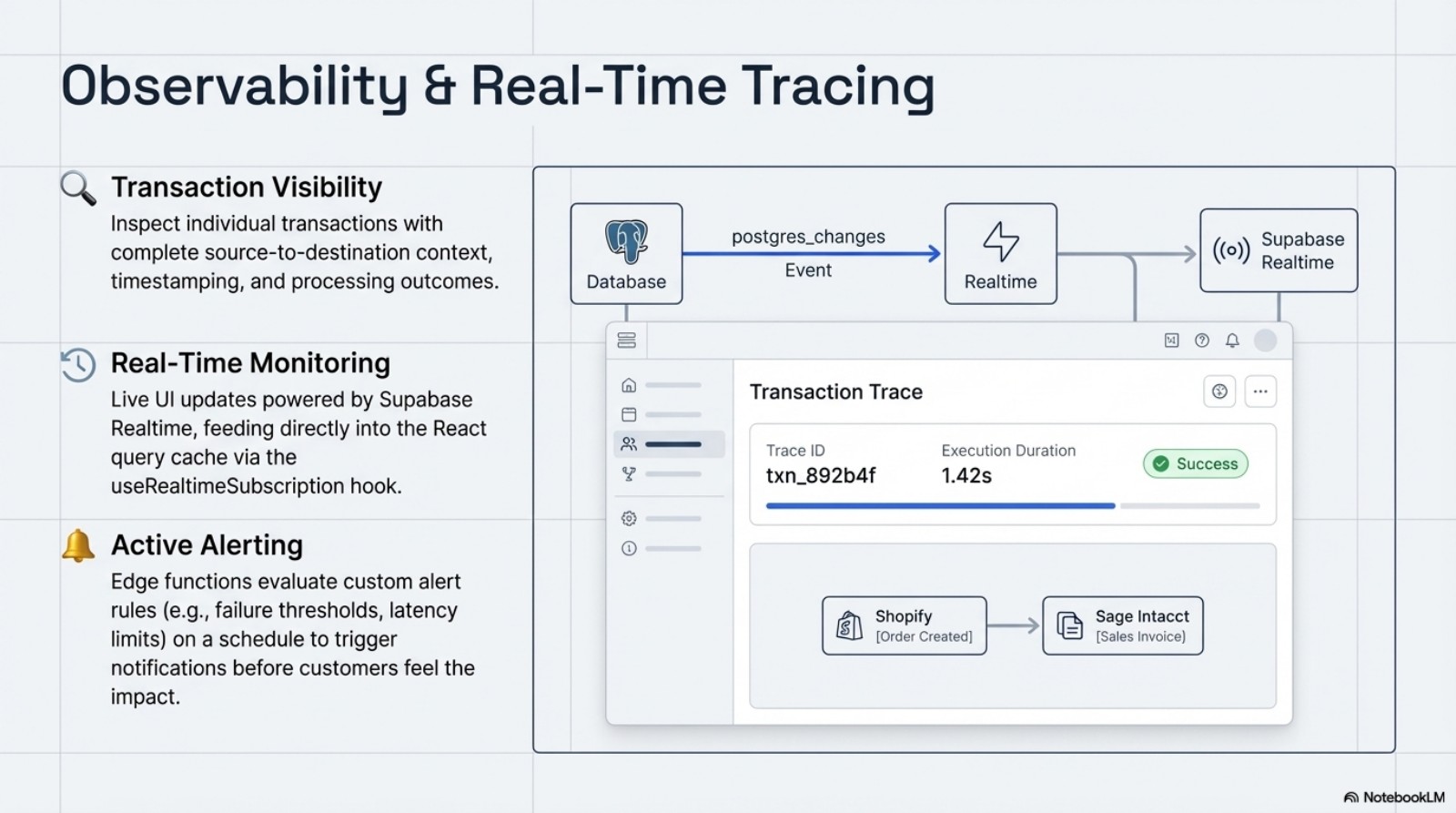
Real-Time Tracing & Observability
Full visibility into every transaction, from webhook ingestion to target system delivery.
Transaction Visibility
Inspect individual transactions with complete source-to-destination context, timestamping, processing outcomes, and execution duration.
Real-Time Monitoring
Live UI updates powered by real-time database subscriptions feed directly into the application state, providing instant visibility into system health.
Active Alerting
Edge functions evaluate custom alert rules — failure thresholds, latency limits, error rate spikes — on a schedule to trigger notifications before customers feel the impact.
Developer & API Extensibility
Full programmatic control over the platform via a REST API with scoped authentication.
API-First Architecture
The REST API provides full programmatic control over the platform, authenticated via scoped API key headers with granular read, write, and admin permissions.
Standard Endpoints
Comprehensive API coverage for /connectors, /flows, /events, /jobs, and /nexus — enabling complete platform automation.
White-Label & Embedded
Tenant-aware architecture allows agencies, VARs, and software vendors to deploy or embed APIWORX as a white-labeled integration layer.